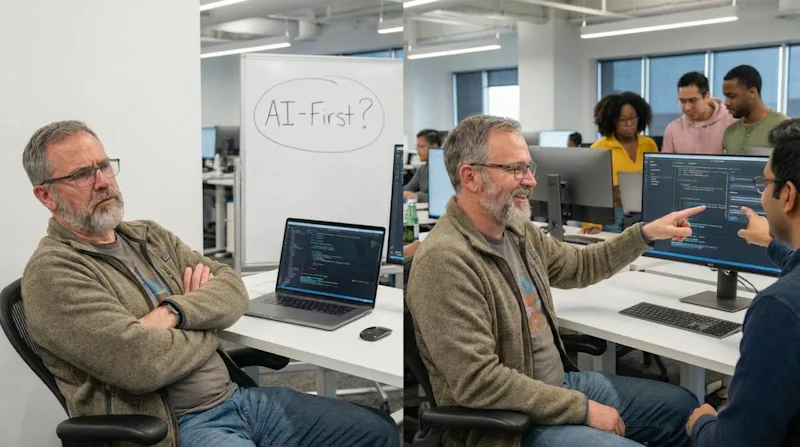
I watched a capable engineering team slow down in real time, and everyone helped cause it.
Not through bad decisions. Through reasonable ones.
More ceremonies to stay aligned. More check-ins to reduce risk. More status updates so nothing slipped. Each change made sense on its own. Together, they dismantled the conditions the team needed to actually build software.
The calendar became the system of record. Focus became collateral damage.
Engineers were treated like execution bandwidth, sliced into meetings, updates, and quick interruptions. Pairing sessions were fragmented. Shared understanding was repeatedly undercut between check-ins. Work did not stop, but progress did. Everything took longer. Decisions got shallower. Momentum never quite returned once lost.
This is the part most teams miss: collaboration does not scale through meetings. It scales through sustained shared context. Shared context is the working mental model a team shares about goals, constraints, decisions, and tradeoffs. And that context is expensive to build and easy to destroy.
We tell ourselves this is the cost of coordination. It is not. It is the cost of mistaking visibility for progress.
If this feels uncomfortable, good. It should.
Most organizations treat coordination as a scheduling problem. If everyone attends the same ceremonies, alignment is assumed. If updates are frequent, risk feels managed. If calendars are full, progress must be happening.
This framing is comforting and deeply flawed.
Software delivery is not limited by how often people talk. It is limited by how long teams can maintain a shared mental model of the system they are changing. That model includes technical constraints, business intent, known risks, and the reasoning behind past decisions. It is built through sustained collaboration instead of repeated interruption.
The common misconception is that meetings create shared context. In reality, most meetings consume context faster than they create it. They interrupt active problem-solving to summarize work mid-flight. They fragment pairing and mobbing sessions.
The problem is harder than it looks because the damage is not immediately visible. Velocity charts lag. Status updates sound reassuring. Everyone feels busy. By the time delays are obvious, the instinct is to add more coordination, which accelerates the decline.
This is why teams with capable people and good intentions still struggle. The system they operate in quietly works against how collaborative thinking actually functions.
The core issue is not too many meetings. It is an unmanaged cognitive load, the cost of stopping, unloading the mental model, and rebuilding it well enough to make a good decision again.
Teams do not fail because they communicate too little. They fail because their shared focus is constantly broken and never fully rebuilt. Every ceremony, check-in, and interruption that disrupts focus increases the cost of the next decision.
This is why protecting focus must be treated as a systems concern, not a personal productivity hack. You cannot ask individuals to compensate for a structure that continuously resets their understanding. No amount of discipline fixes an environment that fragments collaboration by default.
The teams that move fastest are not the ones with the most meetings. They are the ones who protect focus long enough to reason clearly together. The rest of this post will show how ceremony overload disrupts focus, why visibility-driven coordination backfires, and what protecting shared focus looks like in practice.
If there is one thing to remember, it is this: coordination that destroys shared understanding is not coordination at all.
Ceremony Overload Turns Coordination Into Friction
Most ceremonies start with good intent. Standups to surface blockers. Planning to align priorities. Reviews to ensure quality. Retrospectives to improve. Each one has a reasonable purpose.
The failure emerges in accumulation.
As ceremonies multiply, they carve the day into unusable fragments. Pairing sessions are interrupted. Deep discussions are postponed. Decisions are deferred because context is about to be lost again. Teams stop starting hard work because they know it will be interrupted.
What replaces it is shallow progress. Tasks that fit between meetings. Work optimized for explainability rather than impact. The update sounds good. The system does not change.
The subtle cost is decision degradation. When shared context decays, teams default to safer, smaller, more reversible choices. Architecture drifts and technical debt increases quietly. This is not because people are careless, but because the environment discourages sustained reasoning.
This is why adding more ceremonies rarely fixes delivery problems. It feels like action, but it extracts the very thing teams need most: uninterrupted shared focus.
Coordination should reduce friction. When it becomes the primary source of it, the system is misaligned.
Visibility Feels Like Control. It Is Not.
Status updates create the illusion of control. They provide snapshots of activity without preserving the reasoning behind it. Leaders feel informed. Teams feel watched. Neither is aligned.
The problem is that visibility is often treated as an end rather than a byproduct of healthy systems. Instead of asking how work flows, organizations ask for more frequent updates. Instead of improving feedback loops, they increase reporting cadence.
This quietly trains teams to behave in the wrong way. Work gets shaped around what is easy to explain in a meeting instead of what actually moves the system forward. Teams choose safer, smaller changes not because they are better, but because they are easier to report on. Activity increases. Impact does not.
Meanwhile, real risks hide in the gaps between updates, exactly where shared context has decayed. When something goes wrong, the response is predictable: add another meeting.
High-performing teams invert this. They invest in clear goals, explicit constraints, and observable outcomes. Visibility emerges naturally from progress, not from interruption. Leaders trust the system instead of extracting reassurance from the calendar.
Control does not come from knowing what everyone is doing. It comes from designing an environment where good decisions are easy to make together.
What Reducing Focus Disruption Actually Looks Like
Teams that protect shared focus behave differently in visible ways.
They avoid spreading meetings across the day because repeated interruptions disrupt focus. They treat pairing and mobbing time as sacred. They default to asynchronous updates for status and reserve synchronous time for decisions that require shared reasoning. Interruptions are explicit tradeoffs, not ambient noise. A question that breaks a pairing session is treated as costly, not casual. Context switching is acknowledged as real work with real impact.
Most importantly, these teams measure progress by outcomes, not activity. Fewer updates are needed because the system makes progress observable. Fewer meetings are required because alignment is maintained continuously through shared work, not periodically through status.
Nothing here is radical. The difference is intent. Focus is designed for, not hoped for.
A common objection is that reducing ceremonies risks misalignment. Without frequent check-ins, teams might drift or miss issues. This concern is valid, but incomplete.
Misalignment is not caused by fewer meetings. It is caused by unclear goals, weak feedback loops, and poor system design. Meetings often mask these problems rather than solving them.
Another objection is that some interruptions are necessary. This is true. The issue is not eliminating interruptions, but choosing which ones are worth the cost. Treating all requests as equally urgent guarantees maximum disruption with minimal benefit.
Protecting shared focus does not mean isolation or silence. It means intentional coordination that respects cognitive cost. When interruptions are deliberate rather than habitual, teams regain far more than they lose.
Practical Takeaways
- Audit your ceremonies. Remove or merge anything that does not directly support decision-making.
- Keep meetings together instead of spreading them across the day to reduce disruption to focus.
- Protect pairing and mobbing sessions explicitly. Treat interruptions as real costs.
- Default to asynchronous status updates. Escalate to meetings only when shared reasoning is required.
- Make goals and constraints explicit so teams do not need constant clarification.
- Measure progress by outcomes delivered, not updates produced.
- Train leaders to look for system health, not calendar fullness.
These changes do not reduce collaboration. They make it possible.
Teams do not slow down because they stop caring. They slow down because the systems around them quietly erode their ability to think together.
Ceremony overload, constant interruptions, and visibility-driven coordination feel responsible, but they sabotage shared focus at scale. The cost is paid in slower decisions, fragile outcomes, and exhausted teams.
Protecting shared focus is not a luxury. It is core delivery infrastructure. Teams that recognize this move faster with less effort, not more.
The uncomfortable work is not adding another meeting. It is removing the ones that break the system.
Look at your calendar this week and identify the ceremonies that fragment shared focus instead of strengthening it. Remove or redesign just one. If this post made you uncomfortable, share it with the people who help decide what fills that calendar.